
ECMO in Advanced Cardiopulmonary Failure: Patient Selection, Ventricular Unloading and Evolving Support Strategies

For patients with advanced cardiac or respiratory failure, extracorporeal membrane oxygenation (ECMO) can provide temporary cardiopulmonary support while clinicians treat the underlying disease, assess the potential for recovery or determine whether additional definitive therapy is required.
The challenge is not simply initiating ECMO, says I-wen Wang, M.D., Ph.D., cardiothoracic surgeon and System Chief of ECMO and Perfusion with Baptist Health Heart & Vascular Care. Outcomes depend heavily on selecting the appropriate patient, initiating support at the right time and continually reassessing whether the chosen modality is meeting the patient’s evolving physiologic needs.
“The success of ECMO really depends on us choosing the right candidates and right timing for putting patients on ECMO for the right duration,” Dr. Wang says.
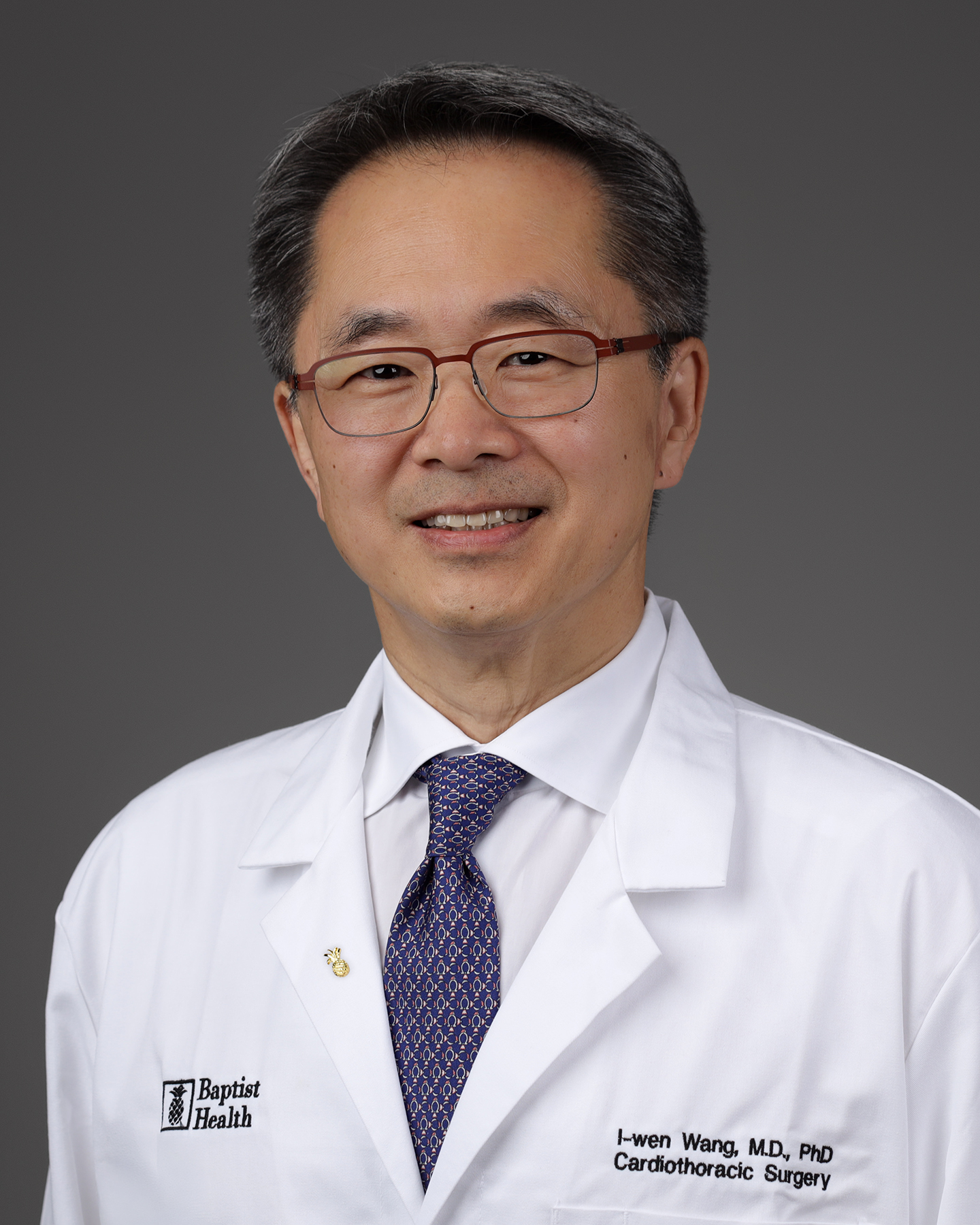
I-Wen Wang, MD
During a recent Baptist Health Heart & Vascular Lecture Series presentation, Dr. Wang reviewed the use of venovenous (VV) and venoarterial (VA) ECMO for advanced lung and heart failure, including how ECMO can be combined with other forms of mechanical circulatory support when a single device does not adequately address a patient’s physiology.
Matching ECMO Support to the Patient
ECMO strategy begins with identifying the dominant physiologic problem.
In cardiac failure, clinicians must determine whether dysfunction primarily involves the left ventricle, right ventricle or both. In patients being evaluated for VV ECMO, the severity of impaired oxygenation or ventilation must be considered along with cardiac function.
Anatomy, vascular access and the anticipated duration of support also influence cannulation and device selection. Patients likely to require prolonged support may benefit from strategies that facilitate extubation, mobility and rehabilitation.
“Patients may present with specific conditions, specific requirements, which may require us to consider different routes of access, the different cannulas that we use, even different pumps,” Dr. Wang says.
The objective is to tailor support to the individual patient rather than apply a uniform ECMO strategy.
VV ECMO for Severe Respiratory Failure
VV ECMO is used primarily for severe respiratory failure, including acute respiratory distress syndrome associated with viral or bacterial pneumonia. It may also be considered for profound hypercapnic respiratory failure when conventional mechanical ventilation cannot provide adequate gas exchange.
Because VV ECMO does not provide direct circulatory support, relatively preserved cardiac function is necessary. One of its principal advantages is allowing clinicians to reduce potentially injurious ventilatory requirements to allow the lungs to recover.
“The purpose of the ECMO assistance is actually to allow the patient to recover most of the time, with the ability to put them on lung-rest settings instead of the sort of punishing mechanical ventilation settings typically required to support them,” Dr. Wang says.
For patients whose pulmonary function does not recover, VV ECMO may also serve as a bridge to lung transplantation.
Dr. Wang cautions against relying too heavily on rigid exclusion criteria. Age, for example, does not necessarily represent an absolute cutoff, and some circumstances historically viewed as contraindications may warrant reconsideration as ECMO technology and management strategies evolve.
“It really just depends on the individual patient and the circumstances of their need,” he says.
VA ECMO in Cardiogenic Shock
VA ECMO provides hemodynamic and cardiopulmonary support and can be rapidly deployed in patients in cardiogenic shock.
Peripheral VA ECMO is commonly established through femoral venous and arterial cannulation. Once systemic perfusion has been restored, however, clinicians must reassess ventricular function, determine whether myocardial recovery is occurring and decide whether the patient should remain on ECMO or transition to another strategy.
“VA ECMO is a therapy for shock,” Dr. Wang says. “It can be rapidly deployed and it allows us to quickly optimize the patient. From there, we can treat the underlying disease aggressively to facilitate recovery or otherwise bridge them to the next definitive therapy.”
Depending on the clinical course, that may mean recovery and decannulation or transition to another form of mechanical circulatory support.
The Importance of LV Decompression
A particularly important consideration during peripheral VA ECMO is adequate left ventricular decompression.
“The ventricle must be decompressed, because if the ventricle stays dilated, there’s really little chance of LV recovery,” Dr. Wang says.
He points to the case of a 19-year-old woman with viral myocarditis and recurrent ventricular tachycardia who was placed on VA ECMO and transferred for further evaluation.
Although ECMO stabilized her circulation, imaging demonstrated that the left ventricle remained significantly dilated and was not ejecting adequately. The team added an Impella microaxial pump to decompress the left ventricle. At this point, whether the patient can recover or will require heart transplant was unclear.
After approximately eight to 10 days of combined support, both devices were removed. The patient recovered sufficient ventricular function and ultimately did not require heart transplantation, Dr. Wang notes.
The case illustrates why stabilization on ECMO should not be viewed as the endpoint of treatment. Continued assessment of ventricular physiology may reveal the need to modify or escalate mechanical support to facilitate myocardial recovery.
Adapting Support as Physiology Changes
ECMO may function as one component of a broader mechanical circulatory support strategy.
Right ventricular failure, for example, can occur following heart transplantation, LVAD implantation and complex cardiac surgery, as well as in patients with pulmonary hypertension. Depending on the clinical need, right ventricular support can be combined with an oxygenator to provide both circulatory and pulmonary assistance.
Support strategies may also change as individual organ systems recover. A patient initially placed on VA ECMO, for example, may regain adequate pulmonary function while significant ventricular dysfunction persists. In that setting, clinicians may transition from ECMO to ventricular assist support rather than continue full cardiopulmonary support.
The ability to modify support according to changing physiology is a central component of ECMO management, Dr.Wang says.
Preventing Complications
Successful ECMO support also requires aggressive treatment of the condition that precipitated cardiopulmonary failure. Dr. Wang says. “We need to aggressively treat the cause of the patient needing ECMO in the first place.” Those underlying conditions may include pulmonary embolism, ARDS or arrhythmias.
Equally important is minimizing complications associated with extracorporeal support.
“And probably the most important thing about successful ECMO management is to avoid complications,” Dr. Wang says.
Bleeding and thrombosis remain major concerns and require individualized anticoagulation management. In patients receiving peripheral VA ECMO, prevention of limb ischemia is also an important consideration. Adequate nutrition becomes increasingly important as the duration of support increases.
Preserving Function During Prolonged Support
For patients requiring extended ECMO support, maintaining physical function can influence recovery and candidacy for subsequent therapy.
Dr. Wang describes patients who have been extubated and able to ambulate while receiving ECMO, including those awaiting transplantation.
“When patients are supported on ECMO for a long time, in order for them to optimize their recovery from ECMO as well as from their next definitive surgery, it’s very important for them to be extubated and to be ambulatory,” he says.
Ultimately, ECMO is best viewed as a dynamic support strategy rather than an endpoint. Patient selection, timing, ventricular assessment, complication prevention and repeated reassessment of the support configuration all influence whether ECMO leads to myocardial or pulmonary recovery—or provides an effective bridge to definitive therapy.
