
Baptist Health Neurosurgeon's Innovation: A New Helmet to Make Surfing Safer

In the world of high-intensity sports, the risk of head injury is a constant concern. While sports like football and hockey have long benefited from advanced protective gear — others, like surfing, have lagged behind.
A new prototype for a dual-shell surfing helmet, designed by a leading neurosurgeon at Baptist Health, has been granted a patent and aims to enhance safety for millions of surfing enthusiasts and professionals worldwide.
The innovator behind this breakthrough is Michael McDermott, M.D., a neurosurgeon, and the Chief Medical Executive and Irma & Kalman Bass Endowed Chair in Clinical Neuroscience at Baptist Health Miami Neuroscience Institute.
As a world-renowned neurosurgeon with expertise in complex brain surgery, Dr. McDermott brings a unique and critical perspective to the challenge of preventing head trauma. His deep understanding of the brain's vulnerability has driven him to look beyond the operating room and toward proactive solutions.
We weren’t aiming to prevent concussions necessarily, but to provide some external protection for the scalp and squamous temporal bone.
Michael McDermott, M.D., a neurosurgeon, and the Chief Medical Executive and Irma & Kalman Bass Endowed Chair in Clinical Neuroscience at Baptist Health Miami Neuroscience Institute
The Catalyst for Change
The inspiration for the helmet was born from a tragic event Dr. McDermott witnessed earlier in his career. He recalls a patient who suffered what initially seemed like a minor injury.
"I had the experience of a patient who had been hit in the temporal region with the tip of his surfboard," Dr. McDermott explains. "He was concussed briefly, felt unwell, but was able to go back to his house." The patient later became unarousable and did not survive due to a fracture and subsequent internal bleeding.
The injury occurred in the squamous temporal bone, an area of the skull just above the ear that is only about two millimeters thick. Dr. McDermott realized that existing protective gear for surfers did not adequately cover this critical zone. This gap in protection, combined with his personal connection to the sport through his sons, spurred him to design a better solution.
Designing for Safety, Comfort, and Visibility
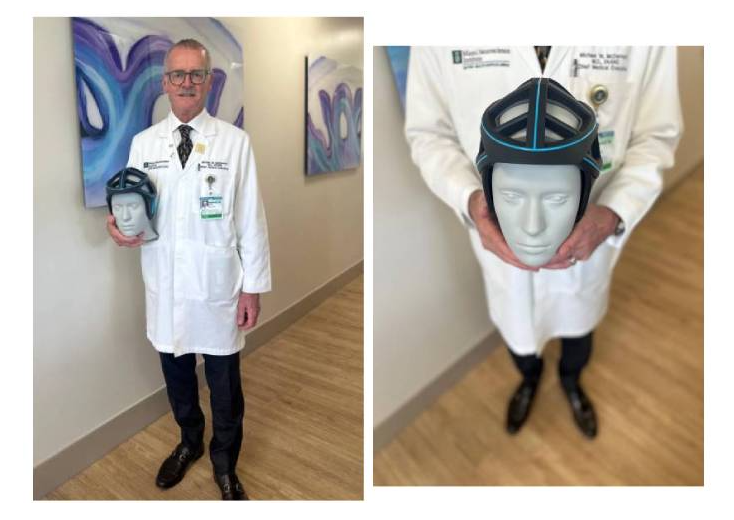
Neurosurgeon Michael McDermott, M.D., holds the prototype for a surfing helmet that he designed.
Dr. McDermott's design addresses multiple risks associated with surfing. The primary goal was to create a helmet that was both protective and unobtrusive, recognizing that surfers value freedom of movement. "Less is more for them," he notes. "So it needed to be something very light."
The helmet's innovative design incorporates several key features:
- Targeted Protection: It is specifically shaped to cover the vulnerable squamous temporal bone, a feature lacking in other available helmets. The design also extends forward into a peak to shield the forehead and eye area, as lacerations to the head and neck account for approximately 40 percent of surfing-related injuries.
- Ear Coverage: The helmet covers the ears with a perforated material that doesn’t block hearing. This feature serves a dual purpose. It helps protect against "surfer's ear," a common condition caused by exposure to cold wind and water, and it shields the ears from the sun, reducing the risk of skin cancer.
- Enhanced Visibility: To address the danger of surfers being hard to spot in large waves, the helmet can be equipped with electroluminescent lighting. This low-voltage, waterproof wire glows, making the wearer much more visible to other surfers, boaters, and lifeguards, especially in low-light conditions.
- Customizable Comfort: An interconnected, inflatable air bladder system allows the user to adjust the helmet's fit for optimal comfort and security. This system can even be synced with a smartphone app to control the internal pressure. The air bladders also contribute to the helmet's buoyancy.
"We weren’t aiming to prevent concussions necessarily, but to provide some external protection for the scalp and squamous temporal bone," Dr. McDermott clarifies. While concussion prevention is complex, reducing the force of direct impacts and preventing fractures is a significant step toward greater overall safety.
From Prototype to Production
The journey from concept to reality has involved collaboration and persistence. Early prototypes were tested by surfers, who reported that after a short adjustment period, they "forgot they even had it on," a testament to the lightweight and comfortable design.
With the support of Baptist Health Innovations, made possible in part through philanthropic generosity powered by Baptist Health Foundation, Dr. McDermott has secured a U.S. patent and is now working with a helmet manufacturer to produce official prototypes. The plan is to develop two versions: a standard model made from high-density plastic for recreational surfers and a high-performance, carbon-fiber model for professionals.
This breakthrough underscores how philanthropy can be a powerful catalyst for innovation, empowering visionary clinicians like Dr. McDermott to transform bold ideas into life-saving solutions.
“The helmet also has an interconnected air bladder system that’s inflatable, so surfers can adjust the pressure for comfort,” explains Dr. McDermott. “The idea is to make the helmet light and buoyant — and while it’s not specifically designed to prevent concussion, it does provide structural support for the temporal bone, ears, scalp, and forehead.”
Broader Implications for Sports Safety
While surfing is the initial focus, the potential applications for this type of protective technology are vast. Dr. McDermott sees possibilities for other water sports, like jet skiing and windsurfing, where helmet use is not yet standard practice. The development reflects a broader cultural shift, similar to how helmets became commonplace in skiing over the last few decades.
Furthermore, this project is part of Dr. McDermott’s wider mission to reduce head injuries across all sports. He has already filed another patent for a multi-sport helmet designed for football, hockey, equestrian sports, and more. This design features a dual-shell system with air bladders and spring-loaded grommets to better absorb impact forces.
As research continues to reveal the long-term dangers of repetitive head trauma, including conditions like chronic traumatic encephalopathy (CTE), innovations like Dr. McDermott's helmet are more critical than ever. By combining medical expertise with inventive design, this new helmet represents a significant advancement in protecting athletes and could pave the way for a new generation of safer sporting equipment.
“Did you know that horseback riding has one of the highest concussion rates?” asks Dr. McDermott. “I didn’t. Soccer players also face head injury risks, but I doubt they’d ever wear helmets. The (multi-sport) patent also covers a dual-shell design with air bladders and rubber spring-loaded grommets that allow the inner and outer shells to collapse on each other, adding extra protection.”
